
A credit balance should be good news. It means you owe someone money. Unfortunately, too many refund experiences turn that good news into a familiar customer-service conversation:
“Your check was mailed.” “When?” “About three weeks ago.” “Should I have received it?” “Probably.”
For healthcare organizations, lenders, insurers, utilities, universities, auto finance companies, property managers and other businesses processing large volumes of refunds, credit balance refunds are more than an accounting task. They are a disbursement problem and a customer experience opportunity.
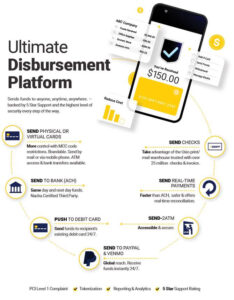
The best credit balance refund solution doesn’t force every recipient into one payment method. It gives organizations multiple ways to return money, including real-time payments, ACH, push-to-debit, digital wallets, cards and checks, while giving recipients greater flexibility in how they receive their funds.
What Is the Best Way to Issue Credit Balance Refunds?
The best approach to credit balance refunds is a multi-rail disbursement strategy. Rather than automatically printing a check, businesses should consider offering eligible recipients several ways to receive their money:
- Real-time payments
- ACH bank deposits
- Push-to-debit
- PayPal and Venmo
- Virtual or physical cards
- Paper checks
Why? Because there isn’t one payment method that’s right for every refund or every recipient. The bigger opportunity is choice.
What Is a Credit Balance Refund?
A credit balance occurs when an organization holds more money on an account than it should ultimately retain. Depending on the industry and situation, that excess balance may need to be returned to the customer, patient, borrower, policyholder, student, member or other recipient.
Credit balances may result from:
- Overpayments
- Duplicate payments
- Account adjustments
- Canceled services
- Insurance or benefit adjustments
- Returned deposits
- Account closures
- Excess balances following a payoff
- Refunds associated with canceled products or services
Those situations differ by industry, but the payments problem is remarkably consistent:
You have someone’s money. Now you need to get it back to them.
At small volumes, that might sound simple. At thousands or tens of thousands of refunds, it becomes an operational challenge.
Consumer Payment Behavior Has Changed. Refunds Should Too.
Consumers increasingly live in an electronic payments world.
Federal Reserve research found that U.S. consumers averaged 46 payments per month in 2023, seven more than in 2022. Credit cards accounted for 32% of payments and debit cards another 30%, meaning the two card types together represented more than 60% of monthly payments. Cash represented 16%. 2024 Findings from the Diary of Consumer Payment Choice
The trend continued in the Federal Reserve Bank of Atlanta’s research covering 2024. Consumers averaged 48 payments per month, approximately 6% more than in October 2023. 2024 Survey and Diary
There’s another statistic that should get the attention of any company designing a modern refund experience: consumers used mobile apps for 50% of person-to-person payments in 2023. 2024 Diary of Consumer Payment Choice
Consumers are clearly comfortable moving money electronically.
Yet many organizations still handle refunds as if everyone’s preferred financial technology is an envelope and a mailbox.
It’s time for the outbound payment experience to catch up.
Why Paper Checks Shouldn’t Be the Default Credit Balance Refund
Let’s be clear: paper checks aren’t dead. Nor should businesses necessarily eliminate them. The question is whether a check should automatically be the first choice when faster digital options are available.
Checks introduce physical steps into what could otherwise be a digital process. They have to be generated, printed, mailed, delivered and ultimately deposited.
And then come the exceptions.
Where is my check? Was it mailed? Can you send it again? I moved. It expired.
Can you just put the money back in my account? Every exception potentially creates additional work around what should have been a simple refund. The better strategy is not necessarily eliminating the paper check. It’s eliminating the paper check as the only choice.
Real-Time Payments for Credit Balance Refunds
This is where credit balance refunds get much more interesting. Real-time payments are especially compelling for refunds because the recipient isn’t waiting to be paid for something new. They’re waiting for money the organization has already determined belongs to them.
Imagine a customer has a $327.42 credit balance. The customer’s primary question isn’t: “When did your accounts-payable department process it?” It’s: “When will I get my $327.42?”
For eligible transactions and recipients, real-time payment capabilities create an opportunity to significantly shorten that experience. But organizations shouldn’t think of real-time payments as a reason to replace every other refund method.
Think bigger.
Real-time payments should become one rail within a multi-rail disbursement strategy. The objective is not simply: Send every refund faster. It’s: Give each recipient an appropriate way to receive their money, including faster options when available.
ACH for Credit Balance Refunds
ACH remains an important option for credit balance refunds because it can deliver funds directly to a recipient’s bank account electronically.
For organizations processing recurring or high-volume refunds, ACH can provide an alternative to generating and mailing physical checks.
There is also an important distinction here: a refund generally involves sending money rather than collecting it. An ACH credit pushes funds from the sender toward the recipient’s account.
For many refund scenarios where instant delivery isn’t required, that makes ACH a logical electronic option.
Push-to-Debit for Credit Balance Refunds
Push-to-debit gives organizations another way to make the refund experience digital.
Instead of waiting for a physical check, funds can be pushed to an eligible debit card.
That can be particularly attractive for consumer-facing businesses because it connects the refund to something many consumers already use routinely: their debit card.
For organizations evaluating refund technology, push-to-debit is worth considering alongside real-time payments and ACH rather than treating all electronic refunds as the same thing.
PayPal and Venmo for Credit Balance Refunds
Sometimes payment innovation isn’t about inventing another way for consumers to interact with their bank.
It’s about meeting them somewhere they’re already comfortable receiving money.
That creates a fundamentally different refund experience.
Instead of telling everyone:
“Here’s how we will refund you.”
Organizations can work toward a model that says:
“Here’s the money we owe you. How would you prefer to receive it?”
That’s a much more customer-friendly conversation.
Virtual and Physical Card Options
Card-based disbursements give businesses another way to structure refunds and other outbound payment programs.
This becomes especially interesting for organizations whose credit balance refund initiative may eventually expand into a broader disbursement program encompassing incentives, reimbursements or other payouts.
Don’t Throw Away the Checkbook Just Yet
Here’s where payment strategy requires a little nuance.
Digital shouldn’t mean digital-only.
Federal Reserve research found a meaningful generational difference in payment behavior. Consumers under 55 used cash for 12% of their payments in 2023, while consumers 55 and older used cash for 22%. 2024 Diary of Consumer Payment Choice
That doesn’t specifically measure refund preferences, but it does demonstrate that payment behaviors differ across consumer groups.
So forcing every person into one electronic refund method could simply create a different kind of friction.
Modernization should increase choice, not replace one rigid system with another.
Paper checks can remain a valuable fallback or preferred option for recipients who want them.
The Better Model: Let Recipients Choose
This may be the biggest opportunity in credit balance refunds.
Stop thinking:
Which payment method should we use for refunds?
Start thinking:
Which payment methods should we make available for refunds?
Depending on eligibility and program requirements, a modern refund experience could give recipients access to choices such as:
Real-time payment when speed is most important.
Push-to-debit when an eligible debit card is the preferred destination.
ACH when a bank deposit makes sense.
PayPal or Venmo when the recipient prefers a digital-wallet experience.
Card-based disbursements when appropriate for the program.
Paper check when physical delivery remains preferred.
That’s not simply payment processing.
That’s payment orchestration around the recipient.
Which Industries Can Benefit From Modern Credit Balance Refunds?
Healthcare
Healthcare offers a natural use case for modern refund disbursements.
When an organization determines that money needs to go back to a patient, the refund process becomes another part of that patient’s financial experience.
The industry’s customer experience shouldn’t suddenly travel backward 20 years just because money is moving out instead of coming in.
A multi-rail approach gives organizations the opportunity to support digital refund experiences while retaining traditional methods when needed.
Auto Finance
Auto finance is another strong use case.
In fact, Usio’s existing automotive materials specifically identify credit balance refunds for auto finance as a potential disbursement/card-issuing application.
When an auto lender or related provider owes a consumer money, the refund doesn’t have to automatically become another check run.
Insurance
Insurance organizations already operate in an environment where significant amounts of money move both into and out of the business.
Credit balance refunds can therefore become part of a broader outbound-payment strategy rather than remaining an isolated accounting process.
Utilities
Utilities can face credits associated with areas such as overpayments, adjustments and account closures.
A flexible disbursement strategy gives utilities additional payment methods to consider when returning those balances.
Higher Education
Colleges and universities operating in an increasingly digital environment should also evaluate whether the way they return funds matches the expectations of the people receiving them.
Providing appropriate electronic choices alongside traditional methods can create a more modern experience.
Financial Services
Banks, credit unions, lenders and other financial-services providers have an especially interesting challenge.
Customers already interact with many financial products digitally. A paper-centric refund process may feel disconnected from the rest of that experience.
How to Choose a Credit Balance Refund Provider
Don’t make your entire evaluation:
“Do you support ACH?”
That’s not enough.
Ask questions that reveal whether a provider can support the larger refund strategy.
Does the provider support multiple payment rails?
Look beyond a single method.
Consider whether the provider can support an appropriate mix of real-time payments, ACH, push-to-debit, wallets, cards and checks.
Can you give recipients payment choices?
There’s a meaningful difference between having six payment products and bringing those products together into a useful disbursement strategy.
Choice is where multi-rail payments become a customer experience.
What happens when the preferred digital option doesn’t work?
The real world is messy.
Digital delivery won’t be appropriate for every recipient or every transaction.
Organizations should evaluate how alternative payment methods fit into their overall refund program rather than designing only for the perfect transaction.
Can the organization track the payment?
Finance teams and customer-service representatives eventually have to answer the most important refund question:
“Where is my money?”
Payment-status visibility should therefore be an important part of the provider evaluation.
Can the platform support other disbursement needs?
This is an often-overlooked question.
Credit balance refunds may be today’s project.
Tomorrow you could be sending:
- Reimbursements
- Insurance-related payments
- Incentives
- Rebates
- Settlement payments
- Supplier payments
- Customer payouts
- Other high-volume disbursements
Your underlying payment infrastructure should give you room to expand.
Why Usio Is a Strong Choice for Credit Balance Refunds
Here’s where Usio’s story becomes particularly compelling.
Usio isn’t limited to one outbound payment method.
Its disbursement materials identify a range of capabilities including real-time payments, ACH bank transfers, push-to-debit, PayPal and Venmo, card issuing, ATM-related disbursements and printed checks. Usio Disbursements Deck
The company’s broader materials also describe an outbound disbursement flow that includes refunds and supports ACH, real-time payments and prepaid card options. Usio Powering the Entire Journey of Money
That’s an important distinction.
Usio doesn’t have to make the argument that one payment rail is the answer to every credit balance refund.
The stronger argument is that businesses need a platform capable of supporting multiple ways to move money out.
That also fits a much larger payments strategy.
Businesses need technology for collecting money.
They also need technology for returning it.
Money in. Money out. One broader payments ecosystem.
The Best Credit Balance Refund Isn’t a Payment Method. It’s a Choice.
The future of credit balance refunds isn’t:
ACH versus checks.
It isn’t:
Push-to-debit versus real-time payments.
And it shouldn’t be:
Digital versus paper.
The better question is:
Why should one payment method have to win?
Real-time payments can serve time-sensitive disbursements. ACH provides electronic bank transfers. Push-to-debit creates another digital option. Digital wallets meet consumers in payment experiences they already use. Cards create additional possibilities. And checks remain available when a physical payment makes sense.
The strongest credit balance refund strategy brings those choices together.
Because the person waiting for a refund doesn’t care about your accounts-payable workflow.
They care about something much simpler:
It’s their money. They want it back.
And the payment provider that helps you return that money quickly, conveniently and through an appropriate payment method creates the better experience.
For organizations ready to move beyond a paper-first refund process, Usio offers the breadth of disbursement options needed to build a more modern credit balance refund strategy.
Recommended Reading from Usio
Want to go deeper into modern outbound payments?
- Start with Digital Disbursements: The Secret Weapon You’re Not Using Yet. The Usio article explores digital disbursements for refunds, reimbursements and other outbound payments and discusses bank accounts, debit cards, wallets and prepaid cards. Read the Usio article
- For finance and operations teams, How Digital Disbursements Drive Efficiency in Corporate Payments looks at digital disbursements for payouts, reimbursements and refunds, including ACH, digital wallets and prepaid cards. Read the Usio article
- For SaaS, fintech and technology teams, How Embedded Payment Solutions Support Faster Digital Disbursements explores outbound payment options including ACH, push-to-card, prepaid debit cards and real-time payments. Read the Usio article