
Every payday, bill payment and bank-to-bank transfer tells the same story: Automated Clearing House (ACH) payments are not an emerging idea. They are part of the infrastructure that keeps the U.S. economy moving.
In 2025, the ACH Network processed 35.2 billion payments worth $93 trillion. Same Day ACH volume reached 1.45 billion payments, an increase of 16.7% from the previous year. Business-to-business ACH volume grew 9.9% to more than 8 billion payments.
The market has embraced ACH. Yet many organizations still struggle to persuade their own customers to use it.
Why?
Because ACH adoption does not depend only on whether a business offers the payment method. Adoption depends on whether people understand it, trust it and can use it without unnecessary friction.
The Real Value of ACH
ACH moves money electronically between bank accounts. It powers familiar transactions such as:
- Direct deposit
- Automated bill payments
- Account-to-account transfers
- Vendor payments
- Recurring payments
That familiarity creates an opportunity. Businesses do not have to teach people an entirely new financial behavior. They need to connect the name ACH to payment experiences customers may already use.
Lower Payment Costs
ACH offers businesses a cost-efficient alternative to payment methods that carry percentage-based processing expenses or require manual handling.
Nacha identifies ACH as costing less than check and card payments, requiring less labor than checks and supporting faster clearing and easier cash application.
The exact savings depend on the processor, transaction volume, payment size, service level and other contractual terms. Businesses should calculate their own economics rather than promise a universal savings figure.
Still, the structure of ACH can make it particularly attractive for:
- Recurring payments
- High-value invoices
- High-volume payment programs
More Predictable Recurring Payments
Cards expire. Customers replace them after loss, theft or suspected fraud. Bank accounts do not have scheduled expiration dates, which can make ACH useful for subscriptions, memberships, installment plans, donations and other recurring payment relationships.
That can create value on both sides:
- Customers can avoid repeatedly entering payment information.
- Businesses can reduce payment-update requests.
- Finance teams can spend less time chasing routine payments.
- Organizations can create more predictable collection workflows.
Greater Control Over Payment Timing
ACH does not force every payment into one speed.
Businesses can use standard ACH for transactions that do not require immediate delivery and Same Day ACH when eligible payments need to move more quickly. Organizations can also schedule payments around known dates and create recurring patterns that support cash-flow planning.
That flexibility matters.
The best payment method is not always the fastest possible method. It is the method that matches the timing, cost and experience required for that transaction.
A Better Alternative to Paper Processes
ACH replaces many check-related steps with an electronic workflow. It can:
- Reduce manual handling
- Support electronic records
- Simplify reconciliation
- Reduce dependence on paper checks
- Support efficient batch processing
But operational value alone will not drive customer adoption.
Customers need to understand what ACH does for them.
Why Customers Still Hesitate
A payment screen does not exist in a vacuum.
When customers see a request for their routing and account numbers, they may immediately ask:
- Who will have access to this information?
- Is this a one-time payment or an ongoing authorization?
- Can the company withdraw a different amount?
- When will the payment leave my account?
- What happens if I see an error?
- How do I stop a recurring payment?
- Is this safer than using my card?
- Why should I change a payment method that already works?
These concerns are not irrational.
Financial information is sensitive, payment fraud is real and authorization language can be confusing.
Federal Reserve research into digital and instant payments illustrates the broader trust problem. Among consumers unlikely to adopt instant payments:
- 48% cited fraud concerns
- 40% disliked registering accounts through multiple applications
- 37% did not want to share account information with other people or businesses
The same study found that processing errors, setup difficulty and insufficient notifications also create payment frustration.
Although those figures focus on instant-payment adoption rather than ACH exclusively, they reveal an important lesson for every bank-account-based payment experience:
People do not adopt a payment method simply because it exists. They adopt it when the experience gives them confidence and control.
Businesses should not answer legitimate concerns with, “Don’t worry, it’s secure.”
They should show customers what they can expect, what they are authorizing and what the organization does to protect the payment process
.
Six Ways to Increase ACH Adoption
- Sell the Customer Benefit, Not the Payment Rail
“Pay with ACH” means something to a payments professional. It may mean very little to a customer.
Lead with the outcome:
- Pay directly from your bank account.
- Set up automatic payments and stop re-entering payment information.
- Choose a one-time or recurring bank payment.
- Avoid mailing a check.
- Receive confirmation when your payment is scheduled.
Then identify the method as ACH.
Plain language removes mystery without hiding what the customer is using.
The message should also change by audience.
A consumer may care most about convenience and control. A business customer may care about payment records, predictable timing and easier reconciliation. A nonprofit donor may care about making recurring support easier.
- Explain the Authorization Before Asking for It
Confusing consent creates distrust.
For recurring consumer payments, Regulation E requires authorization through a writing signed or similarly authenticated by the consumer, and the party obtaining authorization must provide the consumer with a copy.
Consumers also have the right to stop a preauthorized electronic fund transfer by notifying their financial institution at least three business days before the scheduled payment, subject to the regulation’s requirements.
Businesses should work with their legal, compliance and payment-processing teams to create authorization language that clearly states:
- The business receiving permission
- Whether the payment is one-time or recurring
- The payment amount or how it will be determined
- The payment date or frequency
- How the customer can revoke authorization
- How the customer can update account information
- Where the customer can get help
- How the customer will receive a copy of the authorization
Do not bury these details in a long paragraph.
Clear authorization language is not conversion friction. It is trust-building.
- Make Bank-Payment Enrollment Feel Simple
Every unnecessary field, unfamiliar term or unexplained step gives the customer another reason to abandon enrollment.
A strong experience should:
- Use a short, mobile-friendly form.
- Explain why each piece of information is needed.
- Distinguish routing numbers from account numbers.
- Let customers review the amount and timing before confirming.
- Show whether they are authorizing one payment or future payments.
- Provide an immediate confirmation.
- Offer visible access to customer support.
- Avoid asking customers to send financial information through unsecured email or text messages.
Security messaging should remain specific.
If your organization uses encryption, tokenization, account validation or fraud monitoring, say so only when those protections actually apply.
Avoid vague claims such as:
- “Completely risk-free”
- “100% secure”
- “Nothing can go wrong”
Trust grows when businesses explain protections clearly rather than making promises no payment method can guarantee.
- Present ACH as a Real Choice
A payment option hidden at the bottom of a checkout page will not achieve meaningful adoption.
Place bank payments alongside other relevant methods and give customers a reason to consider them.
For example:
Recommended for recurring payments
Pay automatically from your bank account and avoid updating expired card information.
Businesses can promote ACH during:
- Customer onboarding
- Invoice delivery
- Payment reminders
- Billing-support conversations
- Account setup
- Recurring-payment enrollment
- Customer service interactions
Organizations with strong ACH adoption define payment-mix goals, support the effort with messaging and training, promote ACH during onboarding, contact check-paying customers directly and place clear instructions on bills and websites.
The goal is not to eliminate customer choice.
The goal is to make ACH visible, understandable and easy to select.
- Communicate Before and After the Payment
Payment silence creates uncertainty.
Customers should know:
- When enrollment succeeds
- When a payment is scheduled
- The amount that will be transferred
- When the payment is expected to process
- Whether a payment failed or was returned
- What they should do next
- How to cancel or change a recurring authorization
Federal Reserve research found that 82% of surveyed consumers considered immediate notifications important for instant payments because confirmation of funds availability strengthened confidence in the service.
While ACH timing differs from instant-payment timing, the communication principle still applies:
People want to know what is happening with their money.
Do not call every ACH payment “instant.”
Explain whether the organization offers standard, next-day or Same Day ACH and set the appropriate expectation.
- Give Customers a Reason to Switch — and Measure the Result
Habit often presents a bigger barrier than technology.
A limited incentive can prompt a customer to try ACH, particularly when the business shares some of the operational benefit.
Depending on the organization and applicable rules, an incentive might include:
- A one-time account credit
- A small discount
- Waived administrative fees
- Loyalty rewards
- A charitable contribution
- Easier recurring-payment enrollment
Businesses should also track:
- ACH adoption by customer segment
- Enrollment completion and abandonment
- One-time versus recurring usage
- Payment failures and returns
- Support questions
- Opt-outs and canceled authorizations
- Conversion following specific messages or incentives
Measure trust signals, not just transaction volume.
If customers frequently abandon the process after reaching the bank-information screen, the problem may be confidence rather than price.
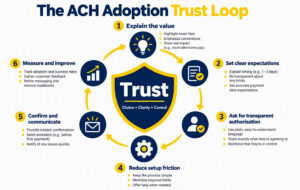
How to Talk to Customers About ACH
Strong ACH communication should feel honest, calm and specific.
Customer-Facing Example
Pay Directly From Your Bank Account
Choose a one-time or recurring ACH payment without mailing a check or repeatedly entering card information.
Before you confirm, you will see the payment amount, scheduled date and whether you are authorizing future payments.
We will send confirmation after enrollment and after each scheduled payment.
Have questions or need to make a change? Contact our payment-support team before submitting your authorization.
Businesses can then add verified details about their security controls, processing times and cancellation procedures.
What Not to Say
Avoid statements such as:
- “ACH is completely safe.”
- “The payment happens instantly.”
- “ACH payments cannot be reversed.”
- “Just give us access to your bank account.”
- “Everyone is switching, so you should too.”
- “You have nothing to worry about.”
These statements either overpromise, oversimplify or dismiss the customer’s concern.
Try This Instead
“ACH lets you authorize a payment directly from your bank account. We clearly show the amount, payment date and authorization terms before you confirm. We also provide a copy of your authorization and instructions for getting help or making a change.”
That language replaces pressure with clarity.
Protect Trust as ACH Grows
Increasing adoption must not mean lowering safeguards.
Nacha’s fraud-monitoring rules require covered non-consumer originators, third-party service providers, Third-Party Senders and financial institutions to establish risk-based processes intended to identify potentially fraudulent ACH entries.
The rules address threats including unauthorized transactions and payments induced through false pretenses, such as:
- Vendor impersonation
- Payroll impersonation
- Business impersonation
- Unauthorized transactions
For businesses, the lesson is straightforward:
ACH growth and fraud management must advance together.
Organizations should align their:
- Payment provider
- Finance team
- Compliance team
- Security team
- Customer-service team
Customer education cannot compensate for weak operational controls, and strong controls cannot compensate for a confusing customer experience.
Adoption requires both.
Make ACH Easier with Usio
Businesses do not need another disconnected payment option. They need a partner that can turn ACH into an integrated, scalable payment experience.
Usio supports:
- Standard ACH
- Same Day ACH
- Recurring ACH payments
- Integrated payment processing
- Account-validation capabilities
- Automated reporting
- Multiple integration options
- Application programming interfaces
- Secure batch-file submission
- Transaction-status webhooks
- Encryption and tokenization for sensitive payment data
Usio is also a Nacha Certified Third-Party Sender.
That experience allows Usio to support organizations that need more than basic ACH origination, including:
- Software companies
- Billers
- Merchants
- Businesses managing complex payment programs
- Organizations processing high payment volumes
The best ACH solution should not simply move money.
It should give businesses the tools to educate customers, simplify enrollment, manage risk, automate recurring payments and build confidence at every step.
Usio brings those capabilities together — so your organization can turn ACH from an available payment method into a payment method customers actively choose.