
Learn how vertical SaaS companies and ISVs increase embedded payments revenue share by adding more payment capabilities and driving higher adoption among downstream merchants.
Embedded payments create a scalable revenue stream for vertical software companies. But integrating payment acceptance represents only the starting point.
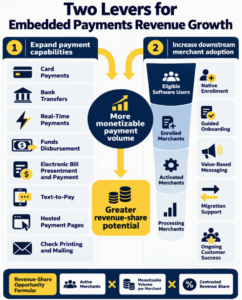
Revenue grows when software platforms pull two levers:
- Expand the types of payment activity the platform monetizes.
- Increase the number of downstream merchants actively using the embedded payments solution.
These levers work together. More payment capabilities give merchants more reasons to use the platform. Greater merchant adoption sends more transactions through those capabilities. Together, they expand monetizable payment volume and increase revenue-share opportunities.
For vertical SaaS leaders, launching embedded payments starts the revenue opportunity. Expanding usage grows it.
The Embedded Payments Revenue Formula
A practical embedded payments model starts with three variables:
Active embedded payments merchants × monetizable payment volume per merchant × contracted revenue share
Transaction pricing, merchant mix, operating costs, risk and commercial agreements all influence actual economics.
Software platforms directly influence two critical inputs:
- How much eligible payment activity the platform supports
- How many eligible merchants process through the embedded solution
That creates a two-part growth strategy:
- Go wider: Add more payment and money-movement capabilities.
- Go deeper: Convert more existing software users into active payment merchants.
Revenue Lever One: Add More Payment Rails and Capabilities
Many platforms begin embedded payments with credit and debit card acceptance.
That creates value, but it captures only one portion of the money moving through the customer’s business.
Consider a legal practice management platform. Its customers:
- Accept card payments from clients
- Collect electronic bank payments
- Present and collect invoices online
- Establish recurring payment plans
- Send refunds or settlement funds
- Pay vendors or other recipients
- Deliver urgent payments in real time
- Print and mail bills when digital delivery better serves the recipient
If the platform supports only card acceptance, much of that payment activity moves through separate providers. Every transaction that leaves the platform takes potential payment revenue with it. The opportunity grows when the platform expands from embedded payment acceptance to embedded money movement.
Add ACH for Bank-to-Bank Payments
ACH supports collections, recurring payments, vendor payments and disbursements.
For a vertical software company, ACH expands the addressable payment base beyond card transactions. It gives downstream merchants another option for larger invoices, recurring payments and transactions where bank-to-bank payments better fit the workflow.
Instead of sending those transactions outside the software, the platform keeps more payment activity inside its ecosystem.
More payment activity inside the platform increases monetizable volume.
Add Real-Time Payments for Time-Sensitive Transactions
Some payment situations demand immediate availability rather than traditional processing windows.
Real-Time Payments address use cases where speed matters, including:
- Lending
- Insurance claims
- Healthcare refunds
- Legal settlements
- Gig-worker payments
- Emergency assistance
- Vendor and contractor payments
A faster payment rail does more than add another payment option.
It creates another transaction use case inside the platform.
More use cases create more transaction opportunities. More transaction opportunities increase payment volume.
Add Funds Disbursement
Embedded payments should address both sides of money movement:
Money in. Money out.
Many software platforms focus heavily on collecting money while overlooking the opportunity associated with sending it.
Depending on the vertical, a platform facilitates:
- Customer refunds
- Insurance claims
- Loan funding
- Legal settlements
- Rebates
- Incentives
- Contractor payments
- Government benefits
- Vendor payments
Usio supports multiple disbursement methods, including ACH, Real-Time Payments, push-to-debit, virtual and physical prepaid cards, paper checks and other payout options.
That breadth expands the software company’s role beyond payment acceptance.
Instead of supporting only the moment when money enters the platform, the software supports more of the complete money-movement lifecycle.
Every additional money-movement workflow expands the transaction opportunity.
Add Electronic Bill Presentment and Payment
Payment collection starts before checkout.
It starts with the invoice, statement or bill.
Electronic Bill Presentment and Payment connects billing and payment collection within the same digital experience.
Instead of generating an invoice in one system and sending the customer somewhere else to pay it, the software platform connects the entire process:
- Present the amount due.
- Give the payer convenient ways to pay.
- Process the transaction.
- Record the payment inside the software workflow.
That connection delivers particular value for billing-heavy platforms serving industries such as:
- Legal
- Healthcare
- Utilities
- Government
- Property management
- Lending
- Insurance
Every additional payment workflow creates another opportunity to keep transactions inside the software ecosystem.
Add Payment Experiences, Not Just Payment Rails
Increasing payment revenue goes beyond adding new rails.
Give customers more ways to initiate and complete payments.
Depending on the software platform and use case, that includes:
- Hosted payment pages
- Text-to-Pay
- In-person payments
- Virtual terminals
- Recurring payments
- Card updating
- Electronic invoicing
- Electronic Bill Presentment and Payment
- Print-and-mail services
- Reporting and reconciliation
Don’t add features simply because they exist.
Identify where money already moves through your customers’ businesses and bring more of those transactions into your software.
That expands the revenue opportunity.
Revenue Lever Two: Increase Downstream Merchant Adoption
Adding payment capabilities expands the potential revenue pool.
Merchant adoption determines how much of that opportunity you capture.
A vertical SaaS company may serve thousands of businesses, practices, firms or locations.
Imagine that only 20% or 30% of those customers use the platform’s embedded payments solution.
The remaining customers still process payments. They simply process those transactions somewhere else.
That makes downstream merchant adoption one of the most important growth opportunities in embedded payments.
Instead of focusing only on acquiring more software customers, ask:
How many of the customers we already have should become payment customers?
Your existing customer base represents an immediate embedded payments growth opportunity.
Make Payment Enrollment Part of Software Onboarding
Don’t treat payments as an optional conversation that begins months after software implementation.
Introduce payments while the merchant configures:
- Billing
- Invoicing
- Deposits
- Recurring payments
- Customer accounts
- Financial reporting
This connects payments directly to the workflow the merchant already wants to improve.
Make the experience feel like activating another capability inside the software—not signing up for an unrelated third-party service.
Put payments directly into the customer journey.
Sell the Business Outcome, Not the Payment Processor
Merchants don’t adopt embedded payments because their software company announces a new processor.
They adopt when they understand what changes for their business.
Lead with outcomes:
- Collect payments without leaving the software
- Reduce duplicate data entry
- Reconcile payments against invoices
- Offer customers more ways to pay
- Send payments and refunds from the same environment
- Track transaction activity inside the platform
- Reduce the number of payment vendors and portals employees manage
The payment solution becomes part of the software’s value proposition.
Sell the workflow improvement, not the processing relationship.
A Legal Software Example: Integration Alone Doesn’t Create Revenue
Consider a legal software platform that embedded payments directly into its software.
The technical integration created the infrastructure.
The real growth opportunity came next:
Get the law firms already using the software to activate and process payments through it.
That distinction matters.
Imagine a software company with:
- 5,000 customers
- A fully integrated payment solution
- Competitive processing capabilities
- A revenue-share agreement
If only a small percentage of those customers process payments through the platform, the software company leaves most of its embedded payments opportunity untouched.
One legal software platform addressed that problem by focusing on implementing and activating downstream law firms so more payment volume moved through the embedded solution.
The strategy provides a straightforward model for other vertical SaaS companies.
Step 1: Identify the Payment Workflow
Determine where customers currently:
- Collect retainers
- Send invoices
- Accept client payments
- Establish payment plans
- Issue refunds
- Send settlement-related funds
Then identify which transactions currently leave the software.
Those transactions represent embedded payments opportunities.
Step 2: Prioritize Eligible Firms
Start with firms already using the software’s billing or invoicing functionality.
They already have a payment need and a natural entry point for embedded payments.
Step 3: Enroll Firms Inside the Platform
Make payment enrollment part of the software experience.
Don’t force customers to discover the payment solution on their own.
Introduce it at the moment when the value becomes obvious.
Step 4: Activate the First Transaction
Enrollment isn’t the finish line.
Processing is.
A merchant that completes an application but never processes a transaction doesn’t create payment volume.
Track the customer through the entire journey:
Eligible → Enrolled → Approved → Activated → Processing
Step 5: Expand the Relationship
Once the firm begins accepting client payments, introduce additional relevant capabilities.
For example:
Card acceptance → ACH → recurring payments → electronic bill presentment → refunds → funds disbursement
Now the platform doesn’t simply increase the number of payment merchants.
It increases the amount of financial activity each merchant conducts through the software.
See How the Two Revenue Levers Work Together
Consider a hypothetical vertical SaaS company with 1,000 downstream merchants.
Today:
- 300 merchants use embedded payments.
- Each active merchant generates $240,000 in annual monetizable payment volume.
- Total monetizable volume equals $72 million.
Now attack both sides of the equation.
First, increase merchant adoption.
Move from 300 active payment merchants to 600.
Then, expand payment capabilities.
Add ACH, Real-Time Payments, Electronic Bill Presentment and Payment, funds disbursement and other relevant payment experiences.
Those additional capabilities increase the hypothetical monetizable volume per active merchant from $240,000 to $300,000.
The result:
| Current Program | Expanded Program | |
| Eligible merchants | 1,000 | 1,000 |
| Active payment merchants | 300 | 600 |
| Adoption rate | 30% | 60% |
| Annual monetizable volume per merchant | $240,000 | $300,000 |
| Total annual monetizable volume | $72 million | $180 million |
The software company didn’t double its customer base.
It generated more value from the customer base it already had.
That’s the power of combining payment expansion with merchant adoption.
This example illustrates the strategy and does not represent a guaranteed or specific customer result.
Don’t Just Ask, “How Many Merchants Do We Have?”
Ask:
How much of each merchant’s money movement happens through our platform?
A merchant already processes card payments through your software.
Great.
But where do its ACH transactions go?
What about invoices?
Refunds?
Disbursements?
Real-Time Payments?
Recurring payments?
Checks?
Every transaction that leaves your platform takes potential payment revenue with it.
The next stage of embedded payments growth comes from increasing payment depth per merchant.
Why Usio Fits a Multi-Rail Embedded Payments Strategy
This is where Usio’s breadth matters.
Usio gives vertical SaaS platforms access to a broad ecosystem of payment acceptance and money-movement capabilities, including:
- Credit and debit card processing
- Embedded payment acceptance
- ACH
- Real-Time Payments
- Funds disbursement
- Electronic Bill Presentment and Payment
- Prepaid and virtual card programs
- Hosted payment pages
- Text-to-Pay
- Recurring payments
- Paper-check disbursement
- Print-and-mail services
- Reporting and reconciliation
That breadth gives software companies room to grow.
Start with card acceptance.
Add ACH.
Add electronic billing.
Add Real-Time Payments.
Add refunds and disbursements.
Add additional money-movement workflows specific to your vertical.
Usio gives you the infrastructure to expand your payments strategy as your customers demand more ways to move money.
More capabilities create more transaction opportunities.
More transaction opportunities increase payment volume.
More payment volume expands your revenue-share opportunity.
Turn Embedded Payments Into a Revenue Growth Program
Embedded payments revenue doesn’t grow because you check an integration box.
It grows when you actively manage the business behind the integration.
Track:
Merchant Adoption
How many eligible software users actually process payments through your platform?
Payment Capability Coverage
How many of your customers’ payment workflows does your platform support?
Payment Depth
How many payment capabilities does each active merchant use?
Monetizable Volume
How much eligible payment activity moves through your platform?
Expansion Opportunities
What payment activity still leaves your software for another provider?
Then work both sides of the equation.
Add more ways to move money.
Get more downstream merchants using them.
Increase the amount of payment activity each merchant processes through your platform.
That’s how embedded payments evolve from a software feature into a meaningful revenue engine.
Increase the Revenue Potential of Your Embedded Payments Strategy
Your customers already move money.
The question is:
How much of that money movement happens through your platform?
Usio combines embedded payment acceptance, ACH, Real-Time Payments, funds disbursement, Electronic Bill Presentment and Payment, card issuing, print-and-mail capabilities and other payment experiences within one ecosystem.
That gives vertical SaaS companies two powerful growth levers:
Capture more types of transactions.
Activate more downstream merchants.
Do both.
Increase the payment volume flowing through your software.
Expand your revenue-share opportunity.
Turn embedded payments into a larger, more strategic part of your business.
Talk to Usio about expanding your embedded payments strategy and capturing more of the money already moving through your software ecosystem.