
In this white paper GovTech leaders will see why payments are becoming one of the most important strategic layers inside digital government. You’ll learn how payment acceptance, disbursements, card issuing, ACH, and more, will move from disconnected back-office functions into embedded platform capabilities. More importantly, you will see how GovTech platforms are using payments to turn money movement into a competitive advantage and to:
- Solve real agency pain
- Reduce manual work
- Improve resident trust
- Expand revenue per customer
- Strengthen retention
The Problem
At 9:47 PM, a resident opens her laptop. City Hall is closed. The phone lines are off. The clerk’s office will not reopen until morning. Democracy, as it turns out, keeps banking hours. But she is not thinking about office hours. She is trying to
renew a business license before tomorrow’s deadline. The form is online. Good. The instructions are clear. Better. She uploads the documents. Then she reaches the payment step. The portal redirects. The fee is not easy to understand. The confirmation never arrives. She does not know whether the payment went through. Now she is staring at her bank app like it owes her an explanation.
The next morning, she calls the agency. The clerk checks one system, then another. Finance cannot see the settlement yet. A refund, if needed, may take days. The software worked. The experience failed. That is one of many quiet crisis inside digital government.
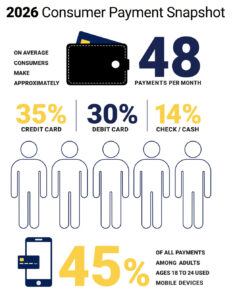
Federal Reserve data and academic research point to the same conclusion: the future of payments is faster, more fragmented, and increasingly tied to trust. For the past two decades, GovTech innovation has focused primarily on digitization. The industry transformed paper-based processes into digital workflows.
Agencies gained online portals, self-service tools, automated communications, electronic records, and cloud-based operations. These innovations dramatically improved efficiency, transparency, and accessibility across government. That work is far from complete. But a new transformation is emerging. The next era of GovTech will not be defined solely by how information moves through government systems.
It will be defined by how money moves through them. Every permit application, utility payment, tax collection, citation, inspection fee, business license, grant program, rebate initiative, benefit distribution, vendor payment, and citizen refund represents a financial interaction. Collectively, these transactions power some of the most critical functions within government.
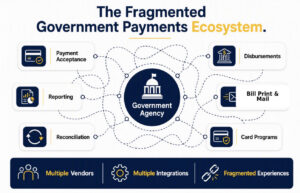
Yet many agencies continue to operate within fragmented payment ecosystems made up of disconnected vendors, siloed technologies, manual reconciliation processes, and inconsistent citizen experiences.
As governments continue modernizing, expectations are changing. Citizens increasingly expect government transactions to mirror the speed, convenience, and transparency they experience with online retailers, healthcare providers, and digital commerce platforms.
They expect to pay, receive, and manage money through simple, intuitive experiences. Agencies expect the same. They want fewer vendors, fewer integrations, greater visibility, stronger reporting, and less operational complexity. This creates a significant opportunity for GovTech providers.
The software companies that successfully bridge the gap between government operations and modern financial experiences will become more than software vendors. They will become essential infrastructure providers.
That distinction matters. Software features can be replicated. Workflows can be copied. User interfaces evolve. But becoming embedded within the financial operations of an agency creates a deeper level of value, differentiation, and long-term strategic importance.
The platforms that help governments move money more effectively will play an increasingly central role in how public services are delivered. This is where embedded finance becomes more than a technology trend. It becomes a business strategy.
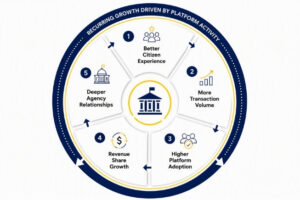
The ability to seamlessly integrate payment acceptance, disbursements, citizen communications, reconciliation, and reporting directly into a platform creates measurable value for agencies while opening new opportunities for software providers. One of the most significant opportunities is revenue share.
For years, payment processing was viewed as an operational necessity. Today, leading software providers recognize that payments will create a recurring revenue stream directly tied to customer activity and platform growth. When structured correctly, revenue sharing aligns incentives across the ecosystem.
Agencies gain modern payment capabilities. Citizens receive a better experience. Software providers participate in the economics generated by transactions occurring within their own platform. The result is a business model where increased adoption, transaction growth, and customer retention can contribute directly to recurring revenue. This is not merely an ancillary benefit. For many software providers, payments have become one of the most scalable and predictable revenue opportunities available within their existing customer base.
Consider Shopify
Shopify began as an eCommerce software company generating revenue primarily through subscriptions. The introduction of Shopify Payments fundamentally changed the company’s economics. By embedding payments directly into the platform experience, Shopify created a revenue stream tied to every transaction flowing through its ecosystem.
More importantly, payments became the foundation for deeper customer relationships, additional financial services, and long-term platform growth. Today, Shopify’s merchant services business generates significantly more revenue than software subscriptions alone.
The Take Away
The lesson for GovTech is not that software companies should become payment processors, nor do they need to. The lesson is that financial infrastructure can become a strategic advantage. Every permit fee, utility payment, court fine, business license payment, tax collection, grant distribution, and citizen refund already exists within government operations. The opportunity is to make those financial interactions a seamless part of the software experience rather than a disconnected process managed elsewhere.
This is where many GovTech providers encounter a challenge. Payment acceptance often comes from one vendor. Government Disbursements come from another. Bill print and mail and Scan2Pay services come from a third. Reporting, reconciliation, and card programs may require additional relationships. Over time, complexity increases. Innovation slows. Support becomes fragmented. The citizen experience suffers.
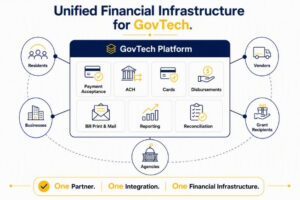
The future points in the opposite direction. Government agencies increasingly want unified experiences They want financial interactions to occur naturally within the workflow they already use. Citizens should be able to make payments, receive refunds, collect benefits, pay invoices, or access government services without being redirected to disconnected systems or third-party experiences with additional login credentials.
For GovTech providers, this means embedded payments are no longer simply a feature. They are becoming a competitive differentiator.
Payments are a Headache
We get it! And, that is why Usio built a white-label payment solution so that you do not have to. Unlike many providers that rely heavily on multiple third-party technologies behind the scenes, Usio delivers a comprehensive financial infrastructure through proprietary technology and in-house operations. This includes embedded payment acceptance, ACH processing, card processing, multi-rail disbursements, card issuing, and bill print and mail services with 5 Star Support.
For GovTech providers, this creates a unique advantage: the ability to embed financial services directly within existing workflows while working with a single partner capable of supporting both the collection and distribution of funds. And, you collect a monthly residual check while Usio does all the work.
Whether an agency needs to accept utility payments, process court fees, distribute grant funding, issue rebates, pay vendors, compensate jurors, deliver emergency assistance, or communicate through printed and mailed notices, those capabilities exist within a unified partner rather than across multiple disconnected providers.
This approach helps simplify operations, improve the citizen experience, reduce vendor complexity, and accelerate innovation. It also creates opportunities for sustainable revenue growth through transparent revenue-sharing programs that align success between the software provider, the agency, and the payment partner.
The future of GovTech is not simply digital. It is financial.
The companies that recognize this shift today will be better positioned to create stronger customer relationships, generate new revenue streams, differentiate their platforms, and help government agencies operate more effectively in the years ahead.
The next decade of innovation will belong to organizations that understand a simple truth: Moving information improves government. Moving money efficiently transforms it. And the platforms that master both will help define the future of public sector technology.
Related Usio Resources
- The Future of Electronic Payments for the Government
- Cities are Switching to ACH
- Are Mutlple Finance Vendors Quielty Killing Your Margins?
- Can GovTech Really Benefit from Payment Montezation?
Sources:
- Federal Reserve Financial Services, 2025 Diary of Consumer Payment Choice, May 2025.
- Federal Reserve Financial Services, 2025 Diary of Consumer Payment Choice Reveals Cash Remains Relevant in an Increasingly Digital Economy, May 13, 2025.
- Federal Reserve Board, Federal Reserve Issues Initial Findings From Its 2025 Triennial Payments Study, July 1, 2026.
- Federal Reserve Board, National Payment Volumes, Top-Line Data CY 2015-24, July 2026.
- Nacha, Same Day ACH Passes Major Milestone in 2024 as the ACH Network Shows Higher Growth, January 30, 2025.
- Nacha, 2024 ACH Network Volume and Value, January 2025.
- U.S. Department of Justice, Fact Sheet: New Rule on the Accessibility of Web Content and Mobile Apps Provided by State and Local Governments, April 2024.
- Federal Register, Nondiscrimination on the Basis of Disability; Accessibility of Web Information and Services of State and Local Government Entities, April 24, 2024. [worldbank.org] PCI Security Standards Council, PCI DSS v4.0.1, June 2024.
- Nacha, Risk Management Topics: Fraud Monitoring Phase 1, effective March 20, 2026.
- Aleisa, Key Factors Influencing E Government Adoption: A Systematic Literature Review, 2024. [federalreserve.gov] Alsalem, Yahya, and Elias, Authentic Digital Interaction with E-Government: A Systematic Review of Key Determinants, 2026 [stlouisfed.org]